
Rhubarb and Tomato Chutney with Grilled Pork Chops
There are some flavour combinations that sneak up on you in the best possible way, and rhubarb with tomato is one of them. Rhubarb is often thought of as a dessert ingredient, tucked into pies, crisps, and jams, but its natural tartness makes it a brilliant partner for savoury dishes as well.

In this dish, rhubarb takes a walk on the savoury side, joining forces with tomato, shallots, garlic, ginger, maple, vinegar, fresh herbs, and The Kilted Chef’s Some Like It Hot Mustard. The result is a chutney that is bright, tangy, a little sweet, and just bold enough to stand up beautifully to grilled pork chops.
The magic of this chutney is in its balance. The rhubarb brings sharpness, the tomato adds body, the maple rounds everything out, and the mustard gives it a gentle kick that keeps every bite interesting. It is not meant to be a smooth sauce. It sits somewhere between a chutney and a compote, with tender pieces of rhubarb giving texture and personality to the plate.
Served over simple grilled pork chops, this chutney does the heavy lifting. The pork is kept uncomplicated, allowing the smoky flavour from the grill and the sweet-tart chutney to shine together. It is the kind of dish that feels rustic, seasonal, and a little unexpected, without being fussy.

This is a great recipe for late spring and summer, when rhubarb is in season and the grill is calling. It works just as well for a weekend supper as it does for entertaining, especially if you want something that feels familiar but has a fresh twist.
The chutney is also wonderfully versatile. Spoon it over grilled chicken, roasted turkey, smoked pork, sausages, or even a sharp cheddar on a board. Make it once, and you will quickly find more ways to use it.
If you have only ever used rhubarb in sweet recipes, this is your sign to try it in a savoury one. Paired with tomato and served over grilled pork chops, it becomes bold, bright, and downright delicious.
Print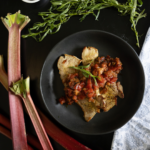
Rhubarb and Tomato Chutney with Grilled Pork Chops
Ingredients
For the chutney
- 1 tbsp unsalted butter
- 2 oz shallots, finely diced or minced
- 1 small garlic clove, grated
- 1 tsp fresh ginger, grated or finely minced
- 10 oz fresh or frozen rhubarb stalks, diced into 1/2-inch pieces
- 1/2 cup maple syrup or sugar
- 1/3 cup apple cider vinegar, rice wine vinegar, or homemade vinegar
- 1/4 tsp kosher salt
- 8 oz tomato puree, preferably from canned peeled tomatoes
- 1 tsp The Kilted Chef’s Some Like It Hot Mustard
- 1 to 2 tbsp fresh tarragon, mint, basil, dill, or chervil, roughly chopped, to taste
For the pork chops
- 4 pork chops, bone-in or boneless
- 2 tbsp olive oil
Instructions
- Heat the butter in a wide two-quart pot over medium heat.
- Add the shallots, garlic, ginger, and rhubarb. Cook for 2 to 3 minutes, stirring often, until the shallots have softened and the rhubarb begins to release some of its juices.
- Add the maple syrup, vinegar, and kosher salt. Bring to a boil, then reduce the mixture by about half.
- Stir in the tomato puree and The Kilted Chef’s Some Like It Hot Mustard.
- Bring the chutney to a gentle simmer and cook for about 15 minutes, stirring occasionally, until the mixture has thickened and the rhubarb has started to soften and break down.
- Do not mash the rhubarb. The chutney should sit somewhere between a sauce and a compote, with tender pieces of rhubarb still tucked throughout.
- Remove the pot from the heat and allow the chutney to cool slightly.
- Stir in the fresh herbs, then taste and adjust the seasoning with more salt, sweetness, or vinegar as needed.
- Preheat the grill to medium-high heat.
- Lightly oil the pork chops.
- Place the pork chops on the grill and cook for 4 to 6 minutes per side, depending on thickness, until nicely marked and cooked through.
- Remove the pork chops from the grill and let them rest for 5 minutes.
- Spoon the rhubarb and tomato chutney over the grilled pork chops and serve warm.
- Refrigerate any remaining chutney and serve later with roasted, grilled, or smoked pork, chicken, turkey, or sausages.
Leave A Comment